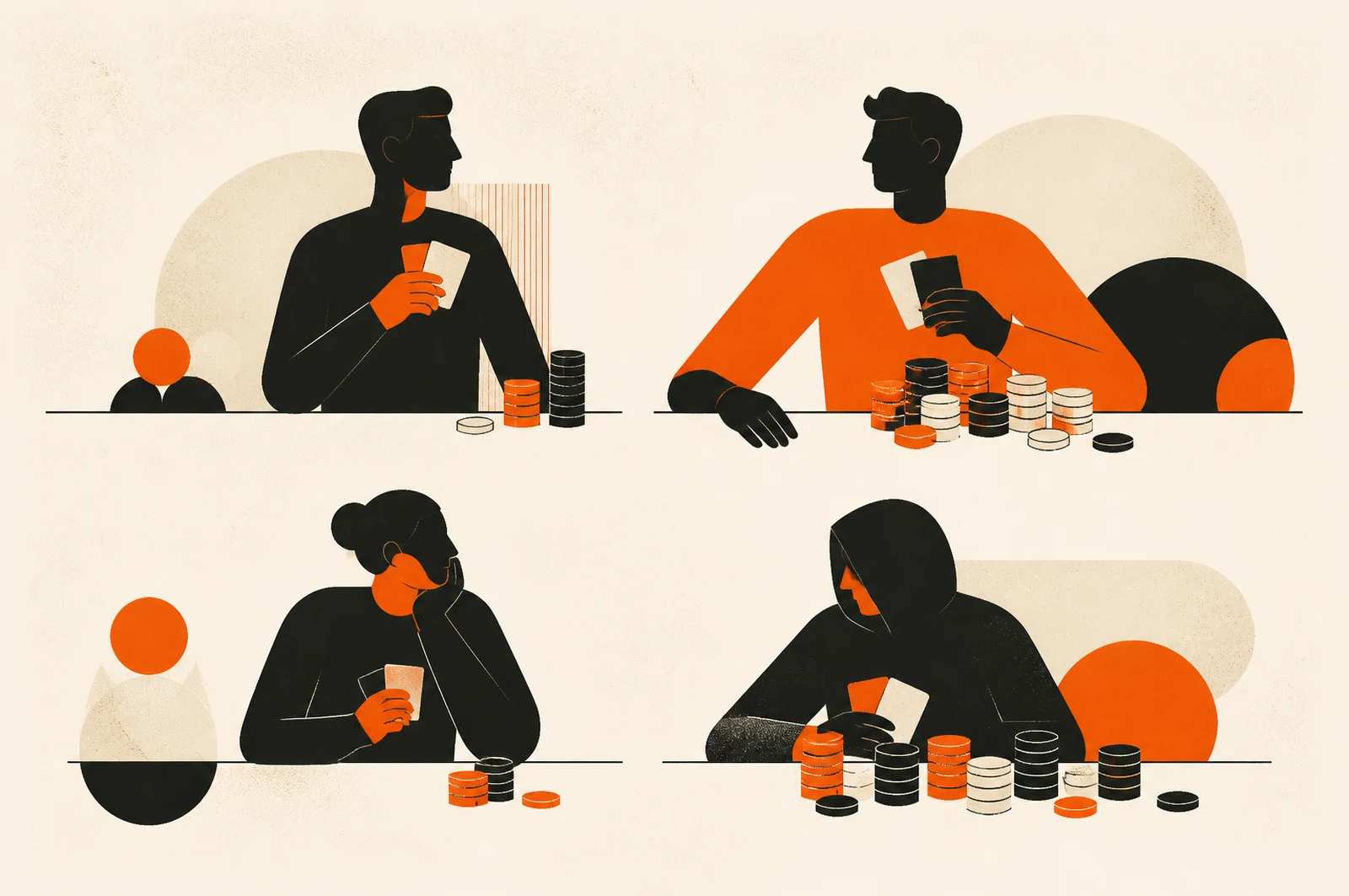
Poker player types are most useful as temporary reads, not permanent identities. Ask two questions:
- How selectively is this opponent entering pots in this situation?
- When involved, do they tend to check and call or bet and raise?
Those questions create four broad profiles: tight-aggressive, loose-aggressive, tight-passive, and loose-passive. The profile gives you a starting point for estimating a range. The opponent's position, stack, sizing, and latest action still decide what to do.
The two axes behind the labels
Tight or loose
A tight player enters fewer pots. A loose player enters more. This is always relative to the situation.
Opening under the gun is different from opening the button. Defending a big blind is different from calling in the small blind. Tournament stack pressure can make the same player look tight in one orbit and active in the next.
Online, VPIP records how often a player voluntarily puts money into the pot preflop. It can help describe participation, but there is no universal number where a player suddenly becomes loose. Look at position, table size, format, and the opportunities they actually had.
Passive or aggressive
A passive player tends to check and call when both passive and aggressive options are available. An aggressive player tends to bet and raise.
Aggressive does not mean reckless, and passive does not mean weak. A strong player can use plenty of checks and calls because the board or range interaction calls for it. A big blind checking to the preflop raiser is not evidence of passivity by itself.
PFR, or preflop raise, helps separate players who enter pots by raising from those who enter mostly by calling. Postflop reads need postflop evidence: betting opportunities, raises, sizings, and showdowns.
The four practical player types
| Type | What the read actually says | Useful starting adjustment |
|---|---|---|
| Tight-aggressive (TAG) | Enters selectively and often takes the betting lead | Give early-position ranges proper respect, then attack only the folds or capped lines you have observed |
| Loose-aggressive (LAG) | Enters widely and applies pressure with bets and raises | Prefer position, avoid weak dominated calls, and continue wider only where the line can contain enough bluffs |
| Tight-passive | Enters selectively and rarely drives the action | Contest pots they repeatedly surrender, but reassess quickly when they show unusual aggression |
| Loose-passive | Enters many pots, often by calling | Bet good hands for value and reduce bluffs in spots where they have shown little interest in folding |
These are range clues, not complete strategies. A player can be loose-aggressive before the flop and passive after it. They can defend the big blind loosely but open tightly. Make the label more specific as you learn more.
Tight-aggressive
A TAG usually folds many starting hands, then enters with a raise more often than a call. That often gives them a stronger range in early positions and more initiative after the flop.
Do not turn that into "TAGs fold to pressure." Some do. Others defend carefully and let opponents bluff into strong ranges. Start by respecting how their entry range changes the available value and bluff combinations. Add pressure only when you have seen a relevant give-up pattern, such as repeatedly surrendering the big blind or checking back too many turns after a flop continuation bet.
Loose-aggressive
A LAG plays more starting hands and takes the betting lead often. Their preflop range can reach the flop with more weak pairs, suited hands, and unpaired cards than a tighter player's range.
The best response is not simply to trap. Position matters more because a wide, aggressive range creates frequent later-street decisions. Cut weak calls that make dominated pairs. Keep strong bluff catchers and value hands available when the observed line contains enough bluffs. A wide preflop range tells you little about a river raise, so read each street on its own evidence.
Tight-passive
A tight-passive player waits for playable hands but often calls or checks instead of raising. This can leave more uncontested pots available when they fold blinds or give up after missing.
Take those pots where the behavior supports it. When this player suddenly raises, however, the new action matters more than the old label. Rebuild the range instead of paying off because you had already decided they were passive.
Loose-passive
A loose-passive player enters many pots and commonly does so by calling. This is the profile often called a calling station.
Against a player who has repeatedly called with weak made hands and draws, shift toward value. Bet hands that can be called by worse, and choose sizes from what the player has actually continued against. Remove low-equity bluffs from lines where they rarely fold.
"Never bluff a calling station" is too crude. A loose caller can still fold when a draw misses, a board becomes frightening, or the price changes. Bluff less because of observed calls in comparable spots, not because the nickname made the decision for you.
Where the familiar nicknames fit
Most poker nicknames describe an extreme point on the same two axes:
- Nit usually means very tight, often with passive tendencies. It does not mean the player will fold every marginal hand.
- Calling station means loose-passive, especially when repeated calls reach showdown with weak holdings.
- Maniac usually describes extremely loose and aggressive behavior. It says nothing by itself about which street is over-bluffed.
- TAG and LAG are direct shorthand for tight-aggressive and loose-aggressive.
Other common terms describe a situation or action, not a player type. A donk bet is a lead into the previous street's aggressor. A short stack changes the available strategy because less money remains behind. Neither tells you how that opponent plays every other spot.
Turn an observation into an adjustment
Use a three-part chain:
Observed action in context
-> likely change to the opponent's range
-> measured adjustment
Suppose a player has called several late-position opens from the big blind and shown down weak offsuit hands. The useful read is not simply "loose." It is "defends the big blind widely against late position." That suggests their flop range contains more weak pairs and unpaired hands than a tighter defender's range.
Your adjustment can now be specific. Start from a wider flop range, but do not value bet thinner until worse hands are observed continuing too often. Choose bluffs that still have equity or can profit from folds on later streets. Do not infer that the same player also calls three-bets loosely from early position. You have not observed that decision.
The same logic applies to aggression. If a player raises many buttons, their opening range is probably wide. You can defend hands that perform well against that range and three-bet for value accordingly. You cannot conclude that their turn barrels or river raises are also too wide until those actions provide evidence.
Let the current action override the label
Take a 100bb cash game. You open the button with:
The big blind calls, and the flop comes:
Against a big blind who has been loose-passive in this exact context, top pair with a strong kicker supports a value-forward plan. Their range can contain many weaker kings, pairs, and backdoor hands that may call.
Now suppose they check-raise. Do not dismiss the raise because "calling stations just call." The current action is stronger information than the old shorthand. Ask which value hands and bluffs take this line, how the sizing changes the price, and what future action remains. The earlier read still informs the range, but it does not cancel what just happened.
This is the central discipline of opponent reading: labels suggest; actions update.
Build reads that become more specific
A useful read gets narrower as evidence arrives.
You might begin with "loose-passive." Later it becomes "calls wide in the big blind against late position, check-calls weak pairs on dry flops, and has shown aggression only with strong made hands." That description is longer, but it leads to much clearer decisions.
Give more weight to:
- Actions taken when the player had a real choice.
- Repeated behavior in comparable positions and stack depths.
- Showdowns that reveal which hands reached a line.
- Bet sizes attached to value hands and bluffs.
- Recent changes that suggest the opponent is adapting.
Act conservatively when the evidence is thin. A single showdown can disprove an absolute belief, but it rarely defines a whole strategy. When new evidence conflicts with the read, narrow it, split it by situation, or discard it.
The size of your adjustment should match the strength of the observation. A tentative read might justify a slightly thinner value bet. A repeated pattern in the same spot can justify a larger range change. This keeps one memorable hand from rewriting your entire strategy.
Review the decisions your reads changed
After a session, find one hand where an opponent label drove your action. Write down:
- The exact behavior you had observed.
- How that behavior changed the opponent's likely range.
- Why your chosen action followed from that range.
- What new evidence would reverse the adjustment.
If you cannot complete the second step, the label was doing too much work.
Review the underlying decision against a solver-grounded reference. Keep the exploit tied to your table evidence, then turn it into a recognition rule you can use the next time the same situation appears.