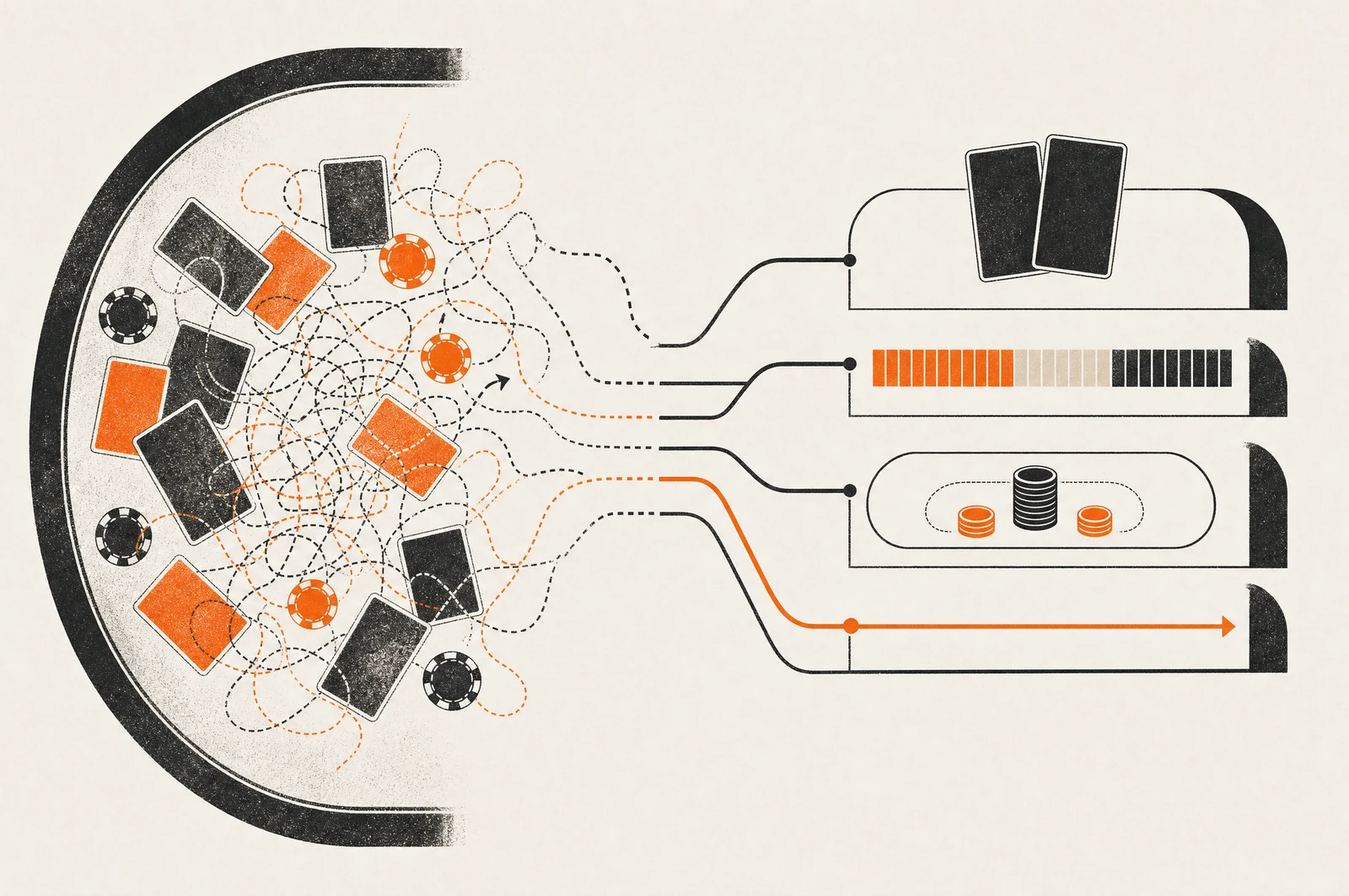
Good poker hand analysis answers one question: what should you recognize and do differently when this decision appears again?
The process is straightforward. Hide the result, rebuild the spot accurately, find the first close decision, compare the two ranges, do the relevant pot and stack math, then examine what each action accomplishes. Finish with one short rule you can carry into the next session.
You do not need to write a report on every street. You do not need to solve every branch. One well-reviewed decision is more useful than ten hands skimmed for confirmation.
Which poker hands should you analyze?
The biggest pot from your session is not automatically the best hand to review. Coolers feel important because they cost a stack. Many contain no meaningful decision.
Start with hands where:
- You considered two plausible actions.
- An opponent used a sizing you did not understand.
- You acted quickly but could not explain why.
- You reached the same uncomfortable type of spot more than once.
- Your plan changed between streets without a clear reason.
Tag the hand during play if your poker client allows it. Write five words about the uncertainty: "turn call versus large barrel" or "which draws keep bluffing?" That note is more valuable than recording whether the river was lucky.
Before reviewing, hide the showdown and the final result. Knowing that villain had the nuts makes every fold look obvious. Knowing that a bluff got through makes every bet feel clever. Neither tells you whether the decision was sound with the information available at the time.
Step 1: Reconstruct the spot exactly
Write down the facts before explaining anything:
- Game format and stakes or blind level.
- Positions.
- Effective stack at the start of the hand.
- Preflop action and sizings.
- Pot size entering the decision.
- Board cards and suits.
- Action and sizing on each completed street.
- The decision you are reviewing.
Heads-up, the effective stack is the smaller stack. Multiway, it depends on how much each opponent can match. If you have 130 big blinds but villain has 52, the important stack between you is 52.
Do not round a three-quarter-pot bet into "about half pot." Do not forget that a player cold-called before the flop. Those details change pot odds, ranges, stack-to-pot ratio, and the meaning of later aggression.
A useful one-line description looks like this:
CO opens to 2.5bb, BB calls, 100bb effective. BB check-calls one-third pot on an ace-eight-four rainbow flop. The turn is a king, BB checks, and CO bets three-quarters pot.
Now everyone reviewing the hand is answering the same question.
Step 2: Write what you believed in real time
Before opening a solver or reading someone else's answer, record your table reasoning.
Keep it honest and short:
- What range did you give villain?
- What did you think your hand was trying to accomplish?
- Which future cards worried you?
- What response did you expect after your action?
- What made the alternative action unattractive?
This step separates a technical mistake from a thinking mistake.
Perhaps your equity estimate was wrong. Perhaps your estimate was fine, but you ignored the price. Perhaps you used a slogan such as "never fold top pair" instead of reading the line. Perhaps you had no river plan when you called the turn.
If you skip this step and jump straight to the answer, you can correct the hand without correcting the process that produced it.
Step 3: Build ranges from the action
Analyze ranges before focusing on your exact cards.
Start preflop. Which hands can each player reasonably hold after the opening, calling, and raising sequence? Then narrow both ranges one action at a time.
Ask:
- Who has more very strong hands on this board?
- Who has more weak hands that missed?
- Which value hands would use this sizing?
- Which draws or weak hands could bluff?
- Which hands would have taken a different line earlier?
Avoid the two common extremes.
The first is giving villain one hand: "They have ace-king." The second is giving villain every hand they could have held preflop even after later actions removed most of them.
A range is a working set of possibilities. It should get narrower as the hand supplies information.
Step 4: Do only the math the decision needs
Most reviews do not need a spreadsheet. They need the correct denominator.
If the pot is 20bb and villain bets 10bb, calling 10bb creates a final pot of 40bb. Your break-even equity is:
call / final pot
10 / 40 = 25%
That does not automatically make the call correct. Your hand must realize enough equity against the betting range, and future action may matter. But now the argument has a threshold.
For bets and raises, ask what the action earns from:
- Worse hands that call.
- Better hands that fold.
- Equity denied to hands that would improve.
- Money lost when the opponent continues with a stronger range.
Also note the stack-to-pot ratio, usually shortened to SPR. With little money behind, a call may effectively commit you to many rivers. Deep stacks make position, future sizing, and nutted hands more important.
Use math to clarify the decision. Do not add calculations that never affect it.
Step 5: Compare the jobs of the available actions
Do not ask only, "What does the solver choose?" Ask what each action is trying to do.
Betting or raising
- Which worse hands can continue?
- Which better hands might fold?
- What equity do we deny?
- What happens when we are raised?
- Does this sizing fit both our value hands and bluffs?
Checking or calling
- Which bluffs stay in villain's range?
- How much equity do we realize?
- Does the hand need protection?
- Which later cards improve or weaken our position?
- Are we protecting a checking range or simply avoiding a decision?
Folding
- Are we below the required equity against a credible betting range?
- Does our combo block value or unblock bluffs?
- Are we folding because the range is strong, or because losing the pot feels bad?
Step 6: Use solver output as a reference, not a screenshot
Once you have formed a view, compare it with a solver-grounded reference. How Railbird works shows the same movement from a hand description to an action and its reasoning.
First check that the solved spot matches your hand closely enough:
- Same positions and preflop structure.
- Similar effective stack.
- Correct pot size and rake assumptions.
- Same board and suits when blockers matter.
- Bet sizes that include the action taken.
Then read from broad to narrow:
- What does the whole range do?
- Which hand classes prefer each action?
- Where does your exact combo sit among nearby hands?
- Are the alternatives far apart in expected value or nearly tied?
- Which blocker, kicker, draw, or future-card property explains the difference?
A mixed action is not an instruction to obsess over a random number. It can mean the actions are close or the hand serves a useful purpose in both branches. Find that purpose before recording the frequency.
For the deeper case against memorizing isolated outputs, read How to Understand Poker Strategy Instead of Memorizing It. This guide is the practical companion: it is what to do with one of your own hands after the session.
Step 7: Write one recognition rule
Finish the review with one sentence.
Bad note:
Call turn 41%.
Better note:
When a small flop bet becomes a large turn barrel, rebuild the betting range and river plan instead of continuing automatically with every top pair.
Bad note:
Do not bluff this river.
Better note:
Prefer river bluffs that block calls and leave missed draws in villain's range; give up the hands with neither property.
The note should describe a cue you can recognize. It does not have to encode the entire solution.
Worked example: Is this river bluff profitable?
The button opens to 2.5bb and the big blind calls. The button holds:
The flop is:
Big blind checks, button bets 3.5bb into 5.5bb, and big blind calls. The turn is:
Big blind checks, button bets 8.75bb into 12.5bb, and big blind calls. The river is:
There is 30bb in the pot and the big blind checks.
The button missed the open-ended straight draw and has no showdown value. Should the button bluff 20bb?
Start with the threshold. A 20bb bluff risks 20bb to win the 30bb pot:
risk / (risk + reward)
20 / (20 + 30) = 40%
The bluff needs folds more than 40% of the time before blocker effects or a possible raise change the calculation.
Now build the river range. Suppose the review produces a deliberately simplified estimate: big blind reaches the river with 12 strong hands that always call and 18 bluff catchers. If 14 of those bluff catchers fold and 4 call, the bet gets 14 folds from 30 hands, or 46.7%.
The expected value of the bluff relative to checking is:
(14 / 30 x 30bb) - (16 / 30 x 20bb)
= 14bb - 10.67bb
= 3.33bb
Under that range estimate, bluffing is profitable. If only 10 hands fold, the fold rate falls to 33.3% and checking wins.
The final combo question is whether ten-nine of clubs makes the estimated fold rate better or worse. Does it block bluff catchers that would fold? Does it block calling hands? Would another missed draw preserve more folds? The bluff is profitable above a 40% fold rate; blockers change your estimate of how often villain folds, not the break-even threshold itself.
Recognition rule:
Before bluffing a missed draw, calculate the fold threshold, count the part of villain's range that can actually fold, then use blockers to choose among your candidate bluffs.
Replay the process on a real hand
The hand below is a separate, real Railbird review. A8o defends the big blind, reaches a low connected flop, improves to a draw on the turn, then faces a river bluff decision. Use the controls to pause before each action. Rebuild the ranges, price the decision, and write your own recognition rule before reading the full analysis.
Look for repetition before calling it a leak
One hand is a lesson. A recurring leak requires a pattern.
After reviewing the decision, search your database for two or three related spots:
- Same positions and pot type.
- Same street and similar sizing.
- Same hand class.
- Similar board family.
If the same reasoning error appears repeatedly, review those hands together and practise that decision family. If it does not repeat, keep the lesson without inventing a larger diagnosis.
This is where hand analysis becomes a study system instead of a collection of stories.
A short poker hand analysis template
Use this after a session:
Spot:
Positions, effective stack, pot, board, action, sizing.

Question:
The first decision where two actions felt plausible.

My table reasoning:
What I thought villain held and what my action would accomplish.

Range view:
Who has the strong hands, weak hands, draws, and natural bluffs?

Math:
Pot odds, SPR, or fold-equity threshold that matters.

Action comparison:
What bet, check, call, raise, and fold each accomplish.

Reference:
What the solver-grounded strategy prefers and why nearby hands differ.

Recognition rule:
One sentence for the next session.

Related hands:
Two or three spots to check for repetition.
How many poker hands should you review after a session?
The best hand-analysis habit is not an occasional three-hour session. It is a short review after play while the uncertainty is still fresh.
Choose one to three decisions. Reconstruct them accurately. Work through the range and math. Check the reference. Write one rule. Return to the table with something you can recognize.