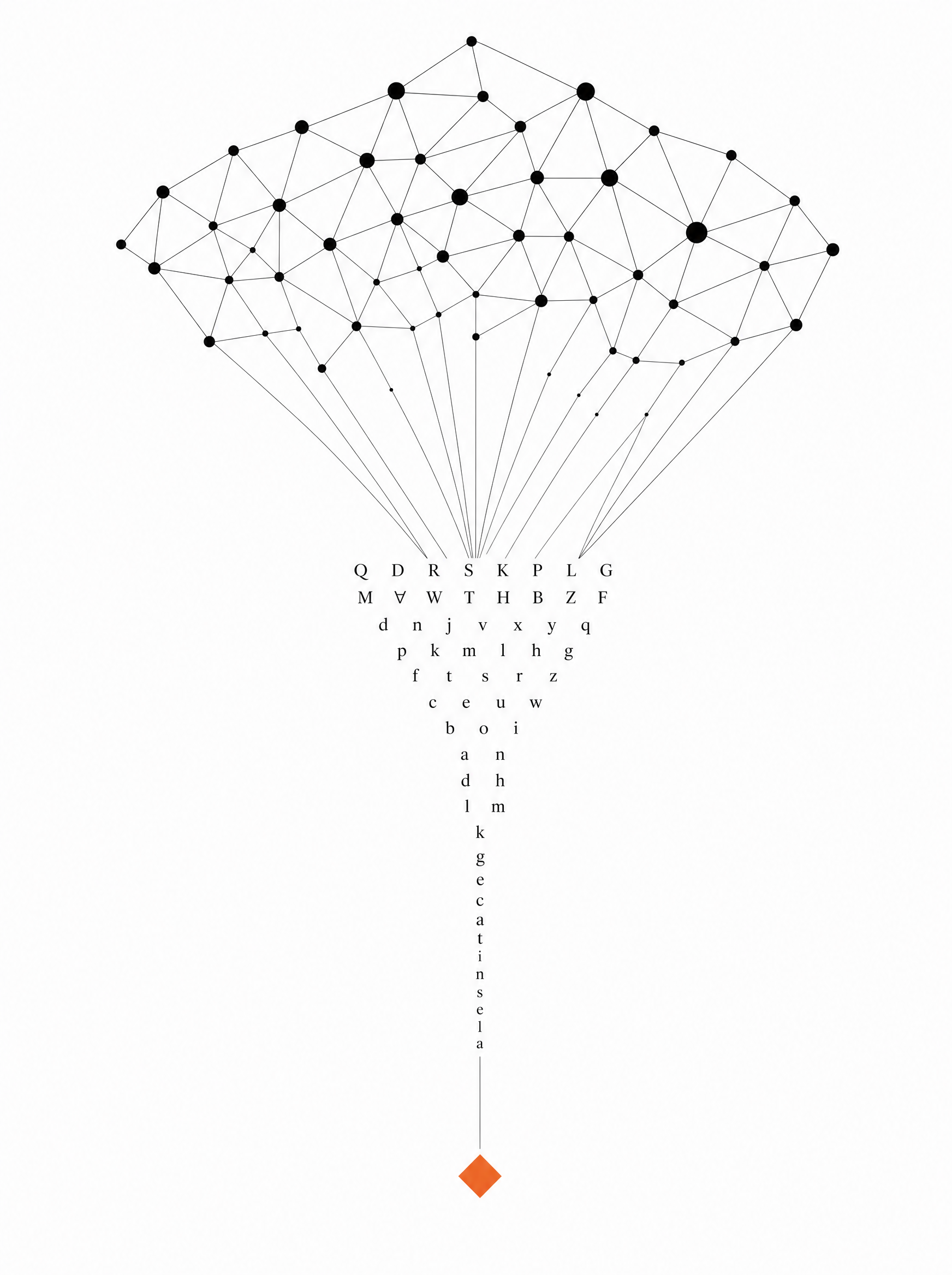
Modern poker study has become very good at producing answers. Solvers compute equilibrium strategies. Study tools render action frequencies with increasing precision. Libraries of solved spots keep growing.
Yet a central problem remains: a frequency is not an explanation.
A frequency is not an explanation.
When a solver says a hand checks 60% and bets 40%, the output identifies the policy. It does not, by itself, explain why that split makes sense. The player still needs to know what forces are balanced, which mistake would be costly, what villain response matters, and how to recognize the same pattern in a different hand.
This note frames that problem as an alphabet problem. Solvers hold strategy as a large web of related spots. Human study runs on a small set of reusable concepts. Explanation is the bridge between them.
Solver accounting
policy
Learned geometry
board-relative
Symbolic alphabet
primitives
Player intuition
rebuilt
A layered explanation system
Railbird treats explanation as a layered problem. At the foundation is solver-grounded accounting: what gets played, at what cost, and which responses matter. Above that sits strategic perception — the pressures, boundaries, and tradeoffs those numbers imply. At the top is the alphabet players actually study with: compact concepts, diagrams, and prose they can reuse at the table.
Symbols should describe strategic structure. They should not overrule it.
In practice, named concepts work best as annotations and constraints, not verdicts. When a label and the underlying incentives disagree, the incentives win.
Explanation as translation
A solver does not think in sentences. It holds thousands of related spots at once. Similar situations group together. A strategic idea might show up as a cutoff inside a range, or a family of hands that respond the same way — not as a tidy phrase. That picture is rich, but it is not readable on its own.
Human study is different. A player cannot absorb a full decision tree or a raw strategy dump. The player needs a small number of stable units: "villain is capped," "this bet denies equity," "checking realizes," "this is a thin-value cutoff," "the hand sits on a mixed boundary."
Those units form an alphabet. An explanation is not merely words attached to a solver output. It is a compression scheme1 — it turns a large strategic picture into a small vocabulary that can be remembered, recombined, and applied in future hands.
serial channel
This framing also avoids a common false contrast. Experts do not think only in language. Strong players often recognize a spot before they can articulate it. Their intuition works the same way: pattern first, words second — board texture, range shape, pressure, and future-card risk felt before they are named.
The expert already has the pattern
Poincare drew exactly this distinction about mathematics. Discovery happens in intuition: geometric, parallel, fast. Proof exists for transmission and checking: serial, symbolic, slow. The two are not rivals. They are different phases of one practice.
serial
channel
The alphabet is not how experts think. It is how expertise moves between minds, and back into a single mind over time, through a narrow serial channel.
Language enters because expertise must pass through a narrow channel. It must move from solver to interface, from interface to player, and eventually from explicit study back into intuition. The goal is not to replace strategic feel with words. It is to use words, diagrams, and named concepts as scaffolding until the pattern becomes internal.
What makes a strategic alphabet good
A useful alphabet for poker explanation has four requirements.
Faithfulness. The symbols must correspond to real structure. A label should track a pattern that actually shows up in the data. If a name does not attach to something stable, it is decoration.
Compositionality. The vocabulary should be small enough to combine. Poker spots are not explained well by one bespoke label per situation. They are explained by reusable parts: strength, vulnerability, fold equity, value extraction, cappedness, pressure, realization, and future volatility.
Graspability. Each unit should be actionable. "Villain is capped" can change a player's plan. "Embedding dimension 47 is high" cannot. A good symbol preserves enough meaning to be faithful while remaining close to how players reason at the table.
Sufficiency. Reasoning in the alphabet should roughly reproduce the solver's conclusion. What is left over — the part the language still cannot say — is the gap worth closing next.
Why poker is a harder explanation problem
Chess engines explain a move. Poker solvers often explain a mixture. At equilibrium, a hand may bet some fraction of the time and check the rest. This is not indecision. It is the result of balanced incentives: betting captures one kind of value, checking preserves another, and either pure strategy may become exploitable if used too often.
Chess engines explain a move. Poker solvers often explain a mixture.
That is why learning solver frequencies alone is not enough. A policy point is a shadow of the equilibrium. The object worth teaching is the structure around it:
A policy point is a shadow of the equilibrium.
- the EV cost of choosing the lower-EV branch;
- the opponent responses that make a bet profitable or fragile;
- the realization value protected by checking;
- the location of the hand relative to a boundary inside the range;
- the blockers or removal effects that make this combo a candidate for one side of the mix.
A player asking "why does this hand mix?" is not asking for the number 60/40. The real question is which strategic forces are in tension and what would break the tie in practice.
That distinction matters because human poker is not played by perfect equilibrium agents. The solver supplies a reference structure, but the player still needs judgment: which opponents overfold, which lines are under-raised, which pools fail to punish imbalance, and which small theoretical indifferences can be simplified in execution.
The explanation layer should therefore separate three authorities:
- Solver accounting - frequencies, EVs, regret, and exact action costs;
- Strategic perception - strength, pressure, vulnerability, cappedness, and realization;
- Player or population read - the exploitative reason to lean away from equilibrium.
Confusing these authorities produces bad coaching. A solver-grounded concept may describe why a bet has fold equity; it should not pretend to know the player should lean bet in a true equilibrium mix unless the relevant exploit read is present.
From hand-written labels to measured concepts
The first version of any strategic alphabet is necessarily editorial. Humans name the concepts because human players must use them. But the boundaries should not remain purely hand-authored.
A deeper system can test candidate concepts against solver-grounded evidence. Spots that should behave alike ought to stay together. Spots that look alike but play differently ought to split apart. Naming stays human; the boundaries get checked against the solver.
Archetypes should become less like brittle rules and more like stable regions in a measured strategic space. The player sees a concept; the system earns that concept by checking it against solver behavior.
This inverts the usual product pattern. Instead of defining labels first and forcing examples into them, the system first studies the strategic structure and then assigns language to the regions that prove stable.
That does not remove human judgment. It gives human judgment a better object. Naming remains editorial. Boundaries become empirical.
Naming remains editorial. Boundaries become empirical.
Toward a notation for solver intuition
The goal is not simply to build another interface that reports optimal actions. Solvers already do that. The more interesting problem is to construct a notation for the strategic forces underneath those actions.
Such a notation would let a player see a hand not only as "check 87%" or "bet 40%," but as a compact composition:
- medium made strength;
- low value extraction;
- high realization value;
- villain still has the top of range;
- future cards matter;
- the mix is low-cost but strategically balanced.
That composition is what can transfer across hands. It is what turns solver study from memorization into pattern acquisition.
The solver provides the reference. The system reads the structure underneath. The alphabet turns that structure into concepts a player can inspect, challenge, and eventually internalize. The long-term goal is not to answer more hands. It is to make solver intuition learnable.
- On explanation as compression. An explanation turns a large strategic picture into a small, reusable vocabulary. The leftover is whatever the language still cannot say.
Part of the Labs track
Technical notes on solver-grounded explanation, strategic language, and poker study systems that transfer.